


If you want to drive a nail, reach for a hammer. Even the best screwdriver will not do the job properly. If you want to drive a screw, no hammer will help. A tool is not good in itself — it is good when it solves a specific problem. Exactly the same applies to diving configurations.
That sounds obvious until we enter the diving world, where choosing equipment surprisingly often stops being a technical decision and begins to resemble a declaration of belief. A single cylinder, twinset, side mount or CCR are no longer simply different tools. They become schools of thought, badges of belonging and sometimes even elements of personal identity. A person no longer says, “I’m choosing side mount for this dive,” but starts thinking, “I’m a side mount diver.” From that moment on, every subsequent dive must be described, planned or interpreted in a way that allows sidemount to prove itself the correct answer once again.
When you have an axe in your hand, everything around you starts to look like a tree.
First the problem, then the tool
There is nothing wrong with a standard configuration. On the contrary, in a particular environment, for a particular type of diving and within a team using shared procedures, it can be enormously valuable. It provides predictability, reduces randomness, simplifies communication and ensures that a teammate knows where to find a specific piece of equipment and what to expect in an emergency. It also allows divers to focus on the dive instead of redesigning their entire equipment setup from scratch every time. A well-considered standard is a starting point built on the experience of many people, and there is no reason to reject it merely for the sake of being different.
The problem begins when we forget that every standard configuration was created in response to a particular set of assumptions. If the diver, task, environment, team or available means of entering the water changes, the right tools may change as well. A solution designed for a long cave penetration does not have to be the best choice for an easy boat dive. A setup that is perfect in a wide passage may become an obstacle in a tight restriction. A configuration that feels intuitive to a right-handed person may be counterintuitive to someone who is left-handed. A setup that works well on a demanding dive may make little sense on a simple recreational one, while something that provides sensible redundancy for one diver may overload another to the point where the redundancy itself becomes a source of problems. After all, even a layperson understands that carrying seven parachutes does not make a skydiver seven times safer.
A standard is not a law of nature. It is a ready-made answer to a previously defined question. Before using it, we should first check whether we are still answering the same question.
This does not mean, of course, that everyone should throw a random collection of components into the back of the car before a dive and assemble them according to their current mood. Flexibility is not equipment anarchy, just as independent thinking does not mean rejecting all the knowledge accumulated before us. Every component should have a clearly defined purpose, work with the rest of the configuration, be easy to operate and not create a greater risk than the one it is supposed to reduce. A diver must be trained to use the chosen configuration, and their teammates must understand it well enough to work effectively alongside them.
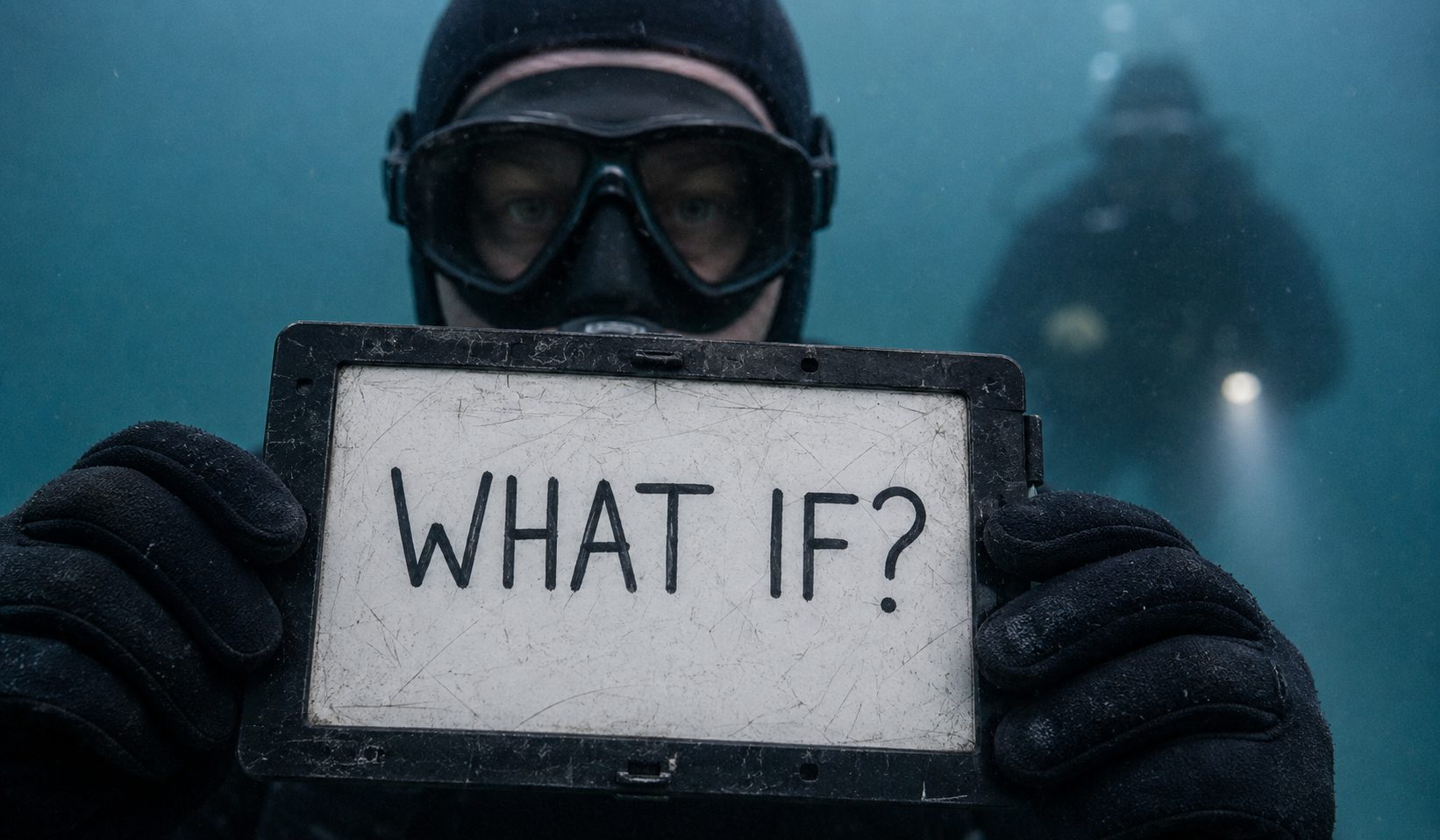
This is why an honest “what if” session matters far more than asking, “Is this how it is done?” What happens if this component fails? Can I reach it under real conditions, not only while standing in front of a mirror? Can I operate it in thick gloves, in zero visibility and under stress? Does the failure of one component affect others? Does my teammate know how to help me? Do I genuinely need this redundancy, or am I merely adding weight, drag and more potential points of failure? How will the configuration behave during entry, exit and transport, in a current, inside a tight restriction or when gas must be donated?
If a solution survives this analysis, has a logical justification and has been practised, it may differ from the solution used by the team next door without being any worse. If it does not, neither popularity, tradition nor a training agency’s logo on a presentation slide will save it. “Because this is how we have always done it” may explain where a solution came from, but it does not prove that the solution is useful.
Keep it simple.
At IDF, we are not opposed to standard configurations. We are opposed to elevating one to the status of dogma and presenting it as the only acceptable answer to every type of diving. We give instructors flexibility, but that flexibility comes with responsibility. If an instructor wants to teach proven, standard solutions because they provide team predictability and suit the conditions in which the training takes place, they are free to do so. If they want to teach that any solution can be valid, provided it has a defined purpose, works with the rest of the configuration and successfully passes a rigorous “what if” session, they are equally free to do that.
In either case, however, the instructor should teach understanding rather than reproduction. A student should know not only where to clip a regulator, but why it belongs there; not only how to route a hose, but what problem its length is intended to solve; not only which fins to buy, but how their stiffness relates to the diver’s strength, technique, exposure protection and the nature of the dives being planned. The solution may be standard, but the explanation should not end with “because the system says so.”
A good diver is not the master of a single configuration. Of course, divers should know and operate their chosen equipment perfectly, but true versatility begins one step earlier: with the ability to recognise which equipment is worth using in the first place. A single cylinder, twinset, sidemount and CCR are not competing religions or successive levels of initiation in which each new tool renders the previous one obsolete. Each solves particular problems, each introduces limitations of its own and each can be an excellent or disastrous choice, depending on what we intend to do.
Side mount can be an excellent answer to restrictions involving space, transport or valve access, but not every diver or dive site needs that answer. A twinset may be easier to manage in open water, but its weight and bulk remain part of the equation. A CCR can radically change what is possible in terms of time, gas and logistics, while introducing different procedures, additional task loading and entirely new ways for a dive to go wrong. A single cylinder, often treated as the “basic” option, may be the most sensible choice for a well-defined task precisely because it does not complicate something that does not need to be complicated. Maturity is not about choosing the most advanced tool, but the simplest one that can safely do the job. Keep it simple.
Diving has no shortage of people who spend half their lives pursuing a doctorate in the elasticity of the bungee attached to a bolt snap. They can spend hours discussing whether it should be four or five millimetres in diameter, at what angle the knot should be tied and exactly how many millimetres of cord may protrude beyond it. They treat every deviation from their configuration almost as a threat to life — and sometimes to the moral order of the entire diving community. Yet when asked what specific problem that piece of bungee is supposed to solve, their answer suspiciously often comes down to: “Because that is how it has to be.”
Precision matters, and attention to detail can determine safety. The problem begins when perfecting one tool replaces the ability to think, and a person spends so long polishing their hammer that eventually every problem looks like nothing but a nail.
Define the problem first. Then choose the tool. Never the other way round.
Ultimately, a diver’s calibre is not defined by how perfectly they use one tool, but by their ability to choose the right one for the task.
CEO IDF
