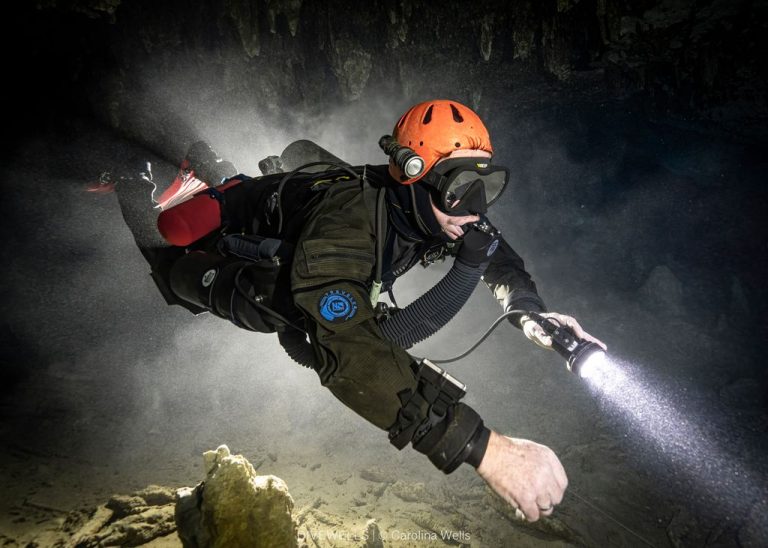
Most online articles about rebreathers cover what can go wrong: oxygen sensors, scrubber duration, electronics, failure modes. Mastering emergency procedures is essential – no argument there. But one thing gets skipped: how to actually dive the thing.
Diving is often advertised as an almost effortless activity. Underwater, with good trim, it really can be that peaceful: the water bears the weight, movements are slow and balanced, and everything seems virtually meditative. The problem is that diving begins and ends on land, where buoyancy doesn’t come into play. Gravity, unlike a cave current, never takes a day off. Does your physical fitness give you enough reserve when something goes wrong?
As far back as I can remember, I always wanted to breathe. As a matter of fact, I started to breathe quite young and it quickly became a daily habit that I intent to keep doing until late in my life. Of course, as I’ve been teaching scuba diving for 45 years now, I know that most divers enjoy breathing on a regular basis, usually around 20.000 times a day, but it’s only recently – as I discovered the Buteyko method and Patrick McKeown’s Oxygen Advantage – that I realized that we don’t always breathe as efficiently as we should. And that, my friend, could be a problem underwater!
Diving with partner certainly is the preferred way of diving. It is described as a safe form of practicing this type of sport. But is this certainly a true statement?
What are checklists and what is their role in diving? What are the pros and cons of checklists? Are they helpful or is it a waste of pre-dive time? How to introduce checklists into your diving practice and what should they contain? You can find the answers to these questions in the latest post by our instructor Daria. We invite you to read.
Manage consent
To provide you with the best possible experience, we use technologies, such as cookies, to store and/or access information about your device. Consenting to these technologies will allow us to process data, such as browsing behavior or unique identifiers on this site. Failure to consent or withdrawal of consent may adversely affect certain features and functions.
Functional
Always active
Storage of or access to technical data is strictly necessary for the legitimate purpose of enabling the use of a specific service expressly requested by the subscriber or user, or for the sole purpose of carrying out the transmission of a message over an electronic communications network.
Preferences
Storage or technical access is necessary for the legitimate purpose of storing preferences that are not requested by the subscriber or user.
Statistics
Technical storage or access that is used exclusively for statistical purposes.Technical storage or access that is used solely for anonymous statistical purposes. Without a subpoena, voluntary compliance from the ISP, or additional records from a third party, information stored or retrieved solely for this purpose usually cannot be used to identify you.
Marketing
Storage or technical access is required to create user profiles for the purpose of sending advertisements or tracking a user on a website or on several websites for similar marketing purposes.