


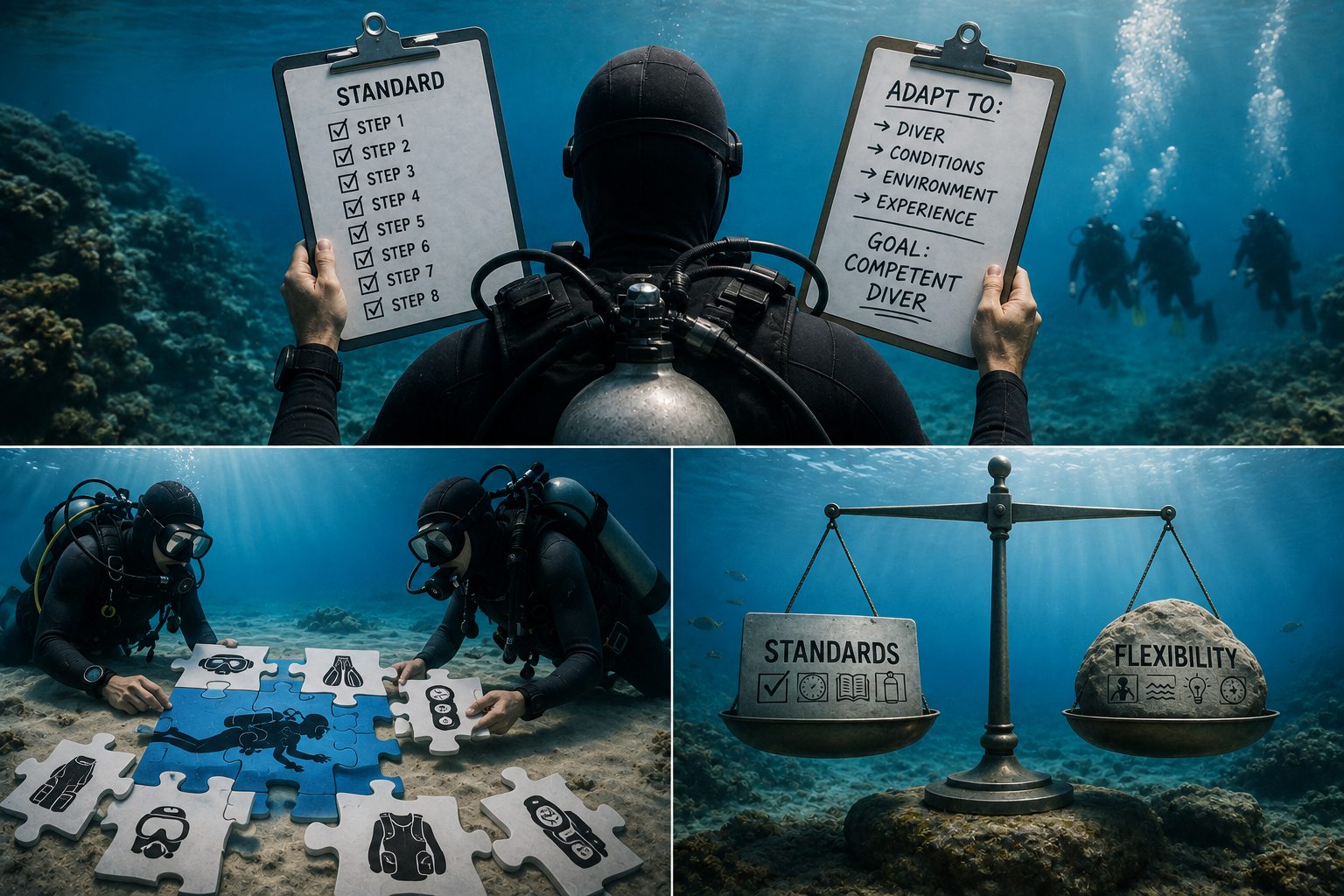
In diving education, the word “standard” tends to carry very positive associations. It suggests order, safety, and predictability, as well as the reassurance that a qualification issued in one place should broadly mean the same thing as the same qualification issued several thousand kilometres away.
At least in theory.
In practice, however, standards tend to expand. They begin by defining what a student is expected to learn, then move on to explaining how it should be taught, in what order the exercises should be conducted, how they should be demonstrated, where the instructor should position themselves, how long each stage should last and, sooner or later, probably even what facial expression should be adopted while discussing an emergency procedure.
At some point, the standard stops being a set of requirements and begins to resemble the script of a performance in which the instructor’s role is simply to follow the directions and deliver their lines.
At the other end of the scale lies flexibility.
That word sounds equally appealing. It suggests experience, common sense, training adapted to the individual student and the ability to respond to the conditions that actually exist rather than those imagined in a classroom or written into a manual. Unfortunately, it is also sometimes used as a rather elegant description of weak requirements, shortened courses and creative interpretations of the rules that, by remarkable coincidence, always seem to result in less work.
The real question, then, is not whether flexibility is better than standardisation.
What matters far more is deciding what should actually be standardised and where a training organisation should leave room for the instructor’s professional judgement. Good training needs both, although not necessarily in equal proportions and certainly not in the same areas.
A standard should be uncompromising about the outcome, but flexible about the route taken to achieve it.
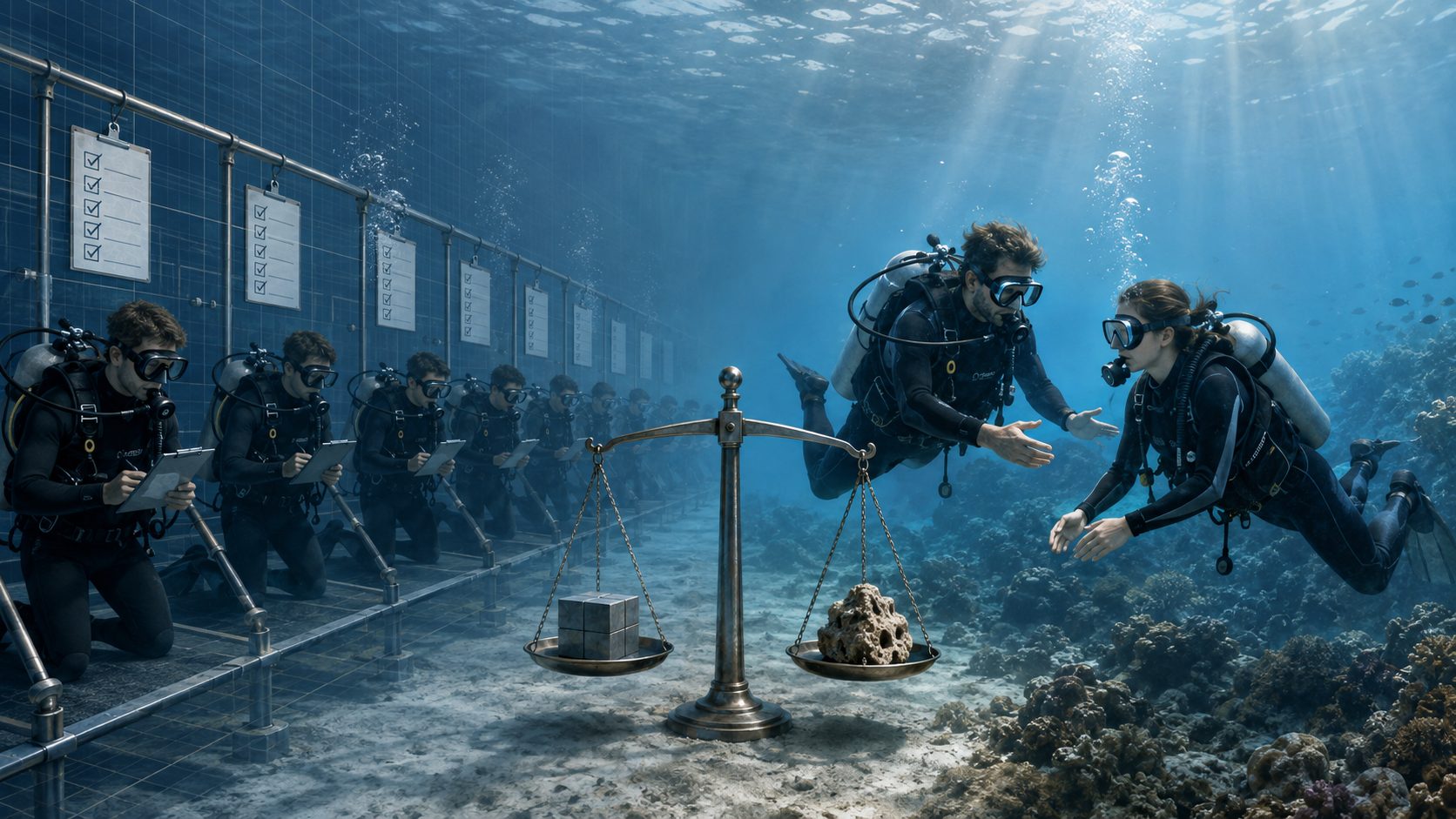
Flexibility within a standard
A useful illustration of this difference can be found in the world of fast-food chains, which are remarkably good at delivering an almost identical product whether we walk into a restaurant in Warsaw, London or Tokyo, or stop at an airport in a country whose name we first noticed on the departures board. The burger looks familiar, tastes familiar, contains roughly the same amount of sauce and probably exactly the same number of pickle slices, because every stage of its preparation has been described, measured, weighed and incorporated into a procedure. The temperature is specified, the cooking time is fixed, the number of ingredients does not depend on the person preparing it, and creative interpretation of the recipe is unlikely to be regarded as a particular advantage.
It is an impressive organisational model, especially when the main objective is complete repeatability and reducing the number of decisions made by the people carrying out the process. There is a reason such systems operate successfully on an enormous scale: they do not require a master chef in every restaurant, only people capable of consistently performing a defined sequence of tasks in accordance with instructions.
The thing is that we do not normally look for the world’s best chefs in places like these.
The best of them are often found in small restaurants where the menu changes with the season, the quality of the produce, the availability of ingredients and the ideas of the person standing in the kitchen. That does not mean they ignore food safety, hygiene, storage temperatures or their responsibility towards their guests. On the contrary, they will usually understand these things far better than the average operator of a procedure, but they also understand that respecting the rules does not require that every movement of the knife, every minute of cooking, and every decision about presentation be standardised.
A good chef knows which boundaries cannot be crossed, understands the result they are trying to achieve and can adapt the technique to the particular ingredients in front of them. It is precisely this ability that separates a master from someone who can correctly follow the operating instructions for a deep fryer.
Diving education is much the same. We can create a system in which every course looks almost identical, every exercise follows the same order, and the instructor moves from one point to the next according to a carefully prescribed plan. The result will be highly repeatable, easy to control, and straightforward to audit, but the question will remain whether our aim is to standardise the course itself or the diver’s standard at the end of it. Those are not the same thing.
Students differ from one another far more than ingredients delivered to a chain restaurant. One may have excellent body awareness and quickly grasp buoyancy control because of a background in sports requiring balance and coordination, while another may spend the first few dives struggling with the equipment, their breathing and their own tension. One person needs a brief explanation and immediately understands the purpose of a procedure; another needs to see it, try it, make a mistake, analyse what went wrong and only then understand why it is performed in that particular way.
There are also students who can reproduce an exercise perfectly but become lost the moment the situation departs even slightly from the familiar script, while someone who is less technically precise may remain calm, assess the problem and make a sensible decision. Training these people in exactly the same way simply because they are taking the same course is neither fairness nor standardisation; it is simply a refusal to acknowledge meaningful differences.
Standardisation should therefore mean that every student is required to achieve a comparable level of competence, not that every student must pass through an identical process at an identical pace. Equal requirements do not demand identical methods, just as a good restaurant need not prepare every dish in exactly the same way to maintain the same level of quality.

The problem is that it is far easier to check whether an instructor has conducted five specified exercises, completed the required number of dives and entered all the relevant information into a form than it is to assess whether the student genuinely understands the limits of their qualification, can manage gas properly, maintains control of buoyancy, responds sensibly when circumstances change and retains those abilities when no longer under the instructor’s direct supervision.
For that reason, some training systems begin to treat the instructor primarily as a programme operator. Their task becomes the accurate reproduction of a procedure, while experience, observation and the ability to adapt the teaching method gradually become less important because compliance with the checklist takes priority. In such a model, an instructor who conducts a hundred courses a year may work little differently from someone who has only just qualified, since both are expected simply to follow the same sequence of steps.
It is, of course, easy to understand where this tendency comes from. The more freedom an instructor is given, the greater the risk that some will use it not to teach better, but to teach more quickly and cheaply. The diving industry has seen more than enough examples of a “flexible approach” meaning fewer dives, shorter sessions or the conclusion that there is no real need to repeat an exercise because “the water is unusually cold today”.
Flexibility therefore cannot mean the right to lower the requirements. An instructor should not be free to decide whether a student needs to master a particular competence, but should be free to choose the most effective way of helping them master it. A federation should clearly define the minimum knowledge, required skills, training conditions, depth limits, instructor-to-student ratios, necessary equipment and certification criteria, but it does not need to prescribe every movement, every demonstration and every method of explanation.
A good standard defines what the student must be able to do.
A bad one tries to predict precisely when they should have learnt to do it.
This is particularly clear in the way minimum numbers of dives are interpreted. If a standard states that a course includes six dives, some instructors begin to regard the sixth dive as the natural end of the training, even though the requirement should mean only that the course may not end any earlier. Six dives are not a magical threshold beyond which competence suddenly appears, just as spending a certain number of hours in a kitchen does not automatically make someone a good chef.
One student may reach the required level in the minimum time; another may need additional dives; a third may need a different teaching method; and a fourth may need a break and a return to more basic elements. Flexibility does not mean doing less; it means being allowed to do things differently, and to do more where more is needed.
Ultimately, every federation has to decide what the instructor is within its system. They can be treated as a potential source of error to be constrained by increasingly detailed procedures, or as a professional entrusted with responsibility for the student’s safety, assessment and development. The first model is administratively more convenient, because compliance can always be checked against a clause, a subclause and a form. The second requires better selection of instructors, meaningful quality assurance and a willingness to assess actual outcomes rather than documentation alone. IDF has chosen the second approach.
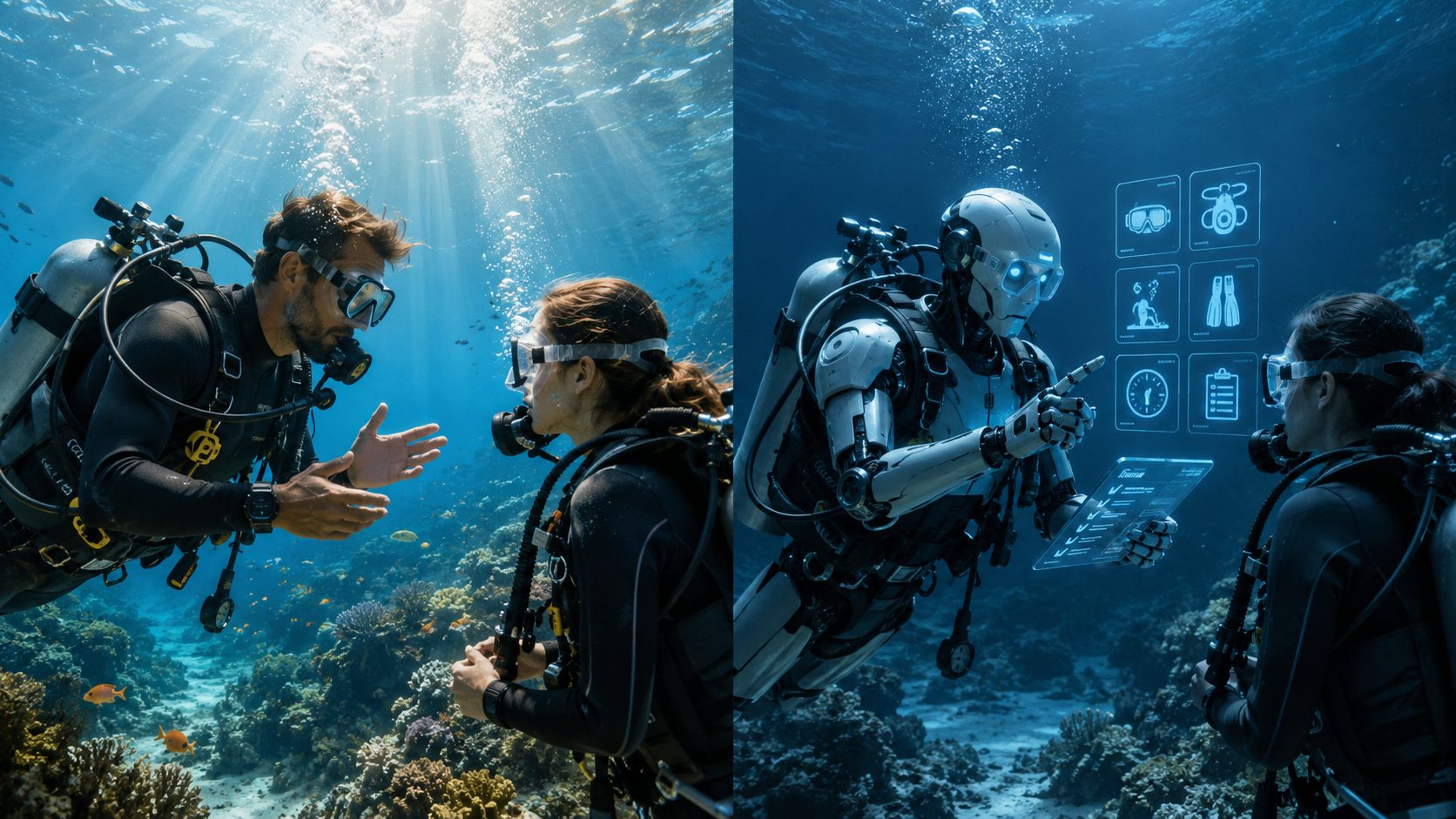
This does not mean blind trust.
A flexible system without effective oversight can very quickly become a collection of local customs in which everyone teaches differently, and everyone is convinced that their own method is the right one, largely because they have been using it for twenty years and no one has yet submitted a formal complaint. Clear boundaries, meaningful quality-control mechanisms, consequences for lowering standards and genuine accountability for the certificates being issued are therefore essential.
Quality assurance, however, should not be reduced to checking whether one course looked exactly like every other. Its primary purpose should be to determine whether the person who received the certificate genuinely represents the level of competence that the qualification promises.
The best standard is therefore not a cage, but a framework. It defines the boundaries, protects the essential elements, ensures consistency, and prevents the most important requirements from being bypassed, while still leaving the instructor enough room to draw on experience, adapt the course to the individual student, and respond to what is actually happening during the training.
A popular fast-food chain can ensure that the product is the same everywhere, regardless of who happens to be standing behind the counter.
A good federation should guarantee something considerably more difficult: that even when training does not look identical across locations, the outcome still meets the same high standard.
We do not believe in complete freedom, because certification without shared requirements quickly loses its meaning. Nor do we believe in a system that attempts to prescribe every decision an instructor makes and reduces their role to following a checklist of steps.
Flexibility without standards leads to chaos, but standards without flexibility lead to training that may be formally correct, easy to control and highly repeatable, yet does not necessarily produce good divers.
The best chefs still work where someone allows them to cook.
The best instructors do too.
CEO IDF
