


Here be dragons
My first underwater encounter with olms struck me like lightning. But let me start at the beginning. Sebastian and I were touring the Balkans, as we so often do, hopping from cave to cave, with a boot full of cylinders, undersuits already beginning to pong, and heads full of ideas. That day the sky was darkening, a downpour was on its way, and we were racing against the clock. One idea was to hole up in the cosy restaurant at our guesthouse and put away an indecent amount of food, so we agreed only one of us would nip in for a quick look at the new site. Guess whose hand went up.
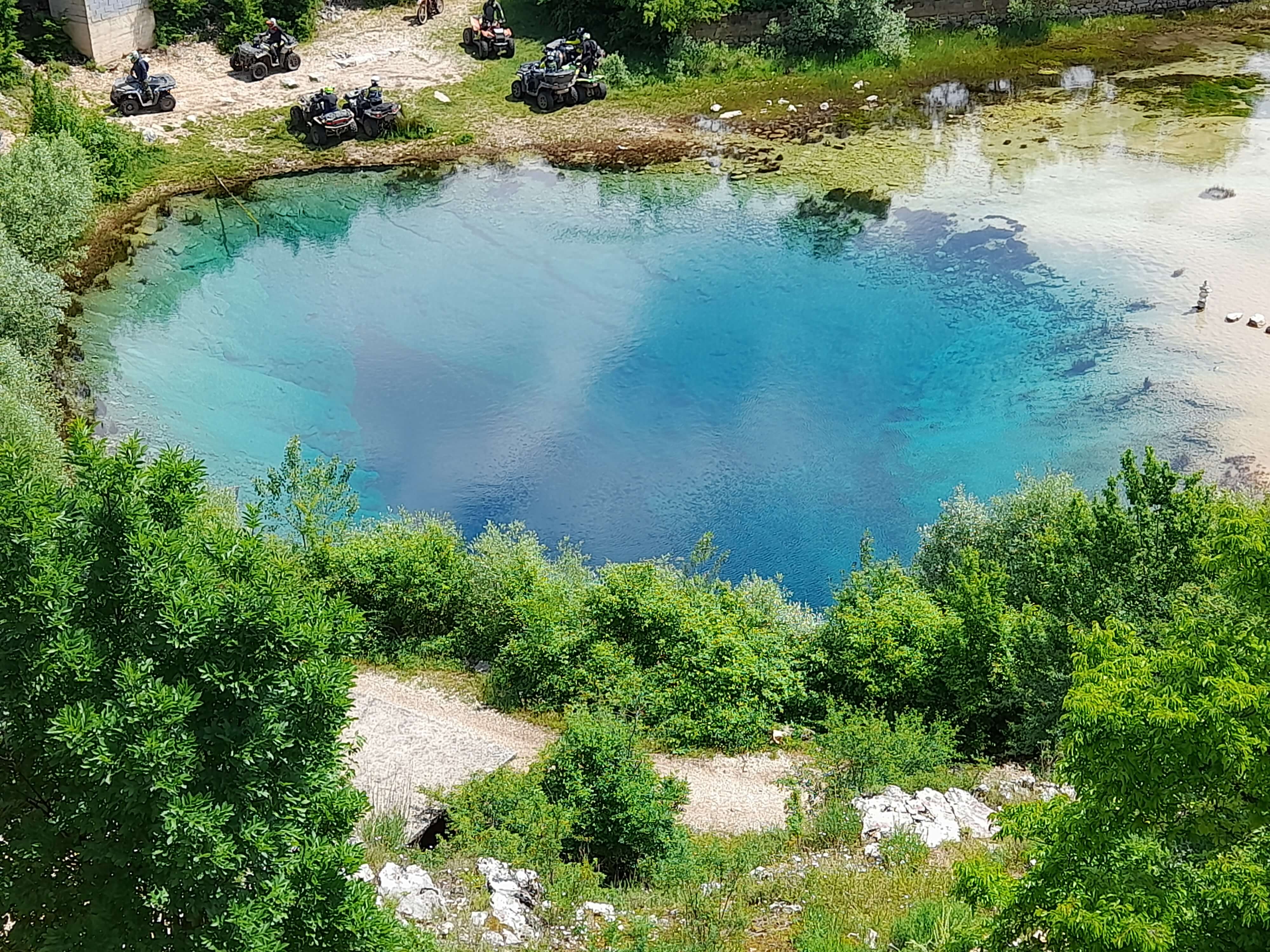
The pool in that swallow hole was, to put it kindly, an eyesore, and the gear carry was long and steep, straight down through the mud. Murky water, a few dead insects floating on top, nothing you’d ever boast about at a dive show. I had volunteered, so in I went. A few metres down I screamed with delight straight into my regulator. Olms were everywhere. On the rocks and in the cracks, big ones and small ones, chubby ones and skinny ones, and a few drifting lazily off into the dark as if they had pressing business to attend to. I switched off my primary light, switched to a much weaker backup, and cupped my hand over it so I wouldn’t spook the locals. Forty-five minutes later, I broke the surface, ripped off my mask and regulator in one go, and bellowed, “Here be dragons!!!”
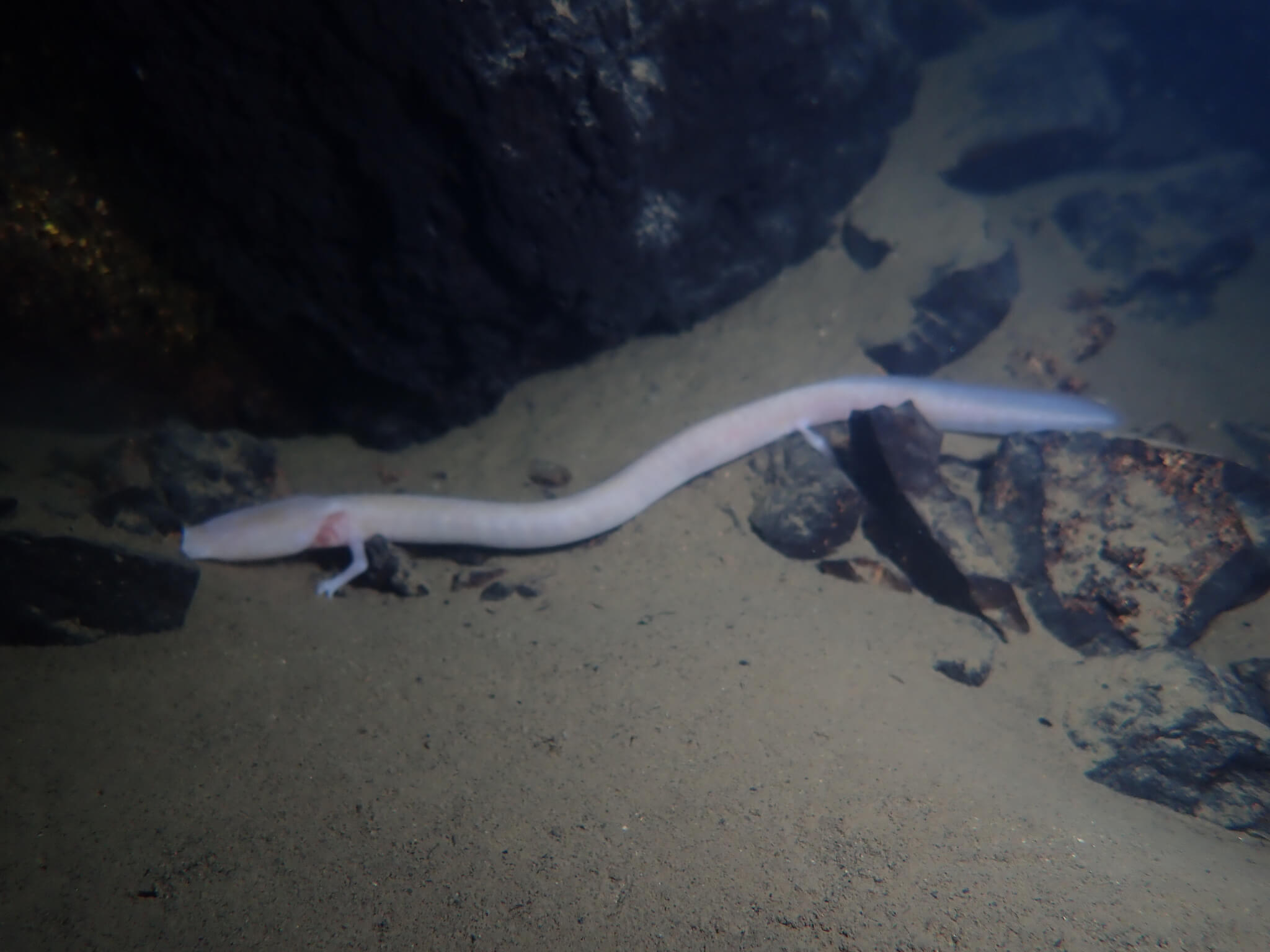
Old legends say people once took olms for baby dragons, washed out of the underworld by floodwater. I can quite see why. These creatures look utterly otherworldly.
But I’m not telling you this because of the dragons. I’m telling you because that dive turned my whole idea of caves upside down. A place I would have walked past a thousand times, just a puddle full of dead flies, turned out to be a bustling city of creatures that have lived in the dark longer than our species has walked the Earth. Nobody had prepared me for that. I found out by accident. It was my bolt from the blue.
And this is where the second half of the story begins, the half nobody talks about on the surface. I am a Course Director and Instructor Trainer. At IDF, I have been responsible from the very start for how divers, recreational and cave alike, learn about the environment they dive in. I write the manuals and design the courses that turn people into cave divers. So I know exactly how much one manual, one course, one instructor can change. And I know how much is still left to do. Because if a fully certified cave diver swims through a living ecosystem without the faintest idea it is alive, someone trained them badly.
That is why this text ends with a promise. The promise is four words long.
Not on my watch.
What lives where light never reaches
Let’s start with the riddle every cave course ought to open with. No sun, no photosynthesis. No photosynthesis, no base for a food chain, so by rights there should be no food chain at all. Yet the darkness teems with life: salamanders, crustaceans, sponges, fish, and whole invisible empires of microbes. Where do they get their energy?
Mostly, they borrow it. Fallen leaves, soil carbon, and dissolved organic matter seep through cracked karst rock, and bacteria, archaea, and fungi, the first guests at the underground table, turn them into food for everyone else (Pacioglu i in., 2023).
So little energy trickles down that whatever reaches the bottom sets the ceiling for everything living above it. Ecologists call this strong bottom-up control. I put it more simply: a cave is a household run on a shoestring, where creatures we will never see do the dirty work.
Sometimes the rock itself foots the bill for life. Movile Cave in Romania has been sealed off from the surface world for about 5.5 million years. Life there runs on hydrogen sulphide, methane, and ammonia, chemistry that would kill us. Everything alive on Earth, us included, is built from carbon. At the surface, the energy to fix it comes from the sun. In Movile, chemolithotrophic microbes burn hydrogen sulphide like fuel and use that energy to build organic carbon from carbon dioxide dissolved in the water. On that foundation grows an entire food web, with invertebrates found nowhere else on Earth (Reboul i in., 2019).
Different fuel, same rules: predation, competition, permanent scarcity. Chemistry literally turning into ecology. Microbes living off sulphur chemistry also show up in science fiction, for instance in Peter Watts’ Rifters trilogy, where an ancient microbe crawls out of deep-sea hydrothermal vents and threatens all life on the surface. But Watts, a marine biologist by training, didn’t conjure any of this out of thin air: nature itself, where such worlds really do exist, gave him the idea. Except that in the real world the roles are reversed. The underground is not a threat to us. We are a threat to the underground.
And we’ve barely begun to explore these unknown waters beneath the surface. Scientists have described more than 5,000 subterranean species in Europe. When the PASCALIS project surveyed seven well-known sites, around 40% of the animals strictly tied to groundwater turned out to be new to science.
Read that again, preferably out loud. Forty per cent. In places already studied (Culver i in., 2019).
The belt between 42° and 46° N, running straight through the Dinaric Karst and the Pyrenees, is one of the continent’s greatest treasure troves of hidden diversity.
Take just one genus: the small amphipod Niphargus. Genetic studies have revealed 245 distinct evolutionary lineages in the Western Balkans alone and 512 in a wider dataset, all hiding inside bodies that look almost identical (Borko i in., 2022). Next time you shrug at a “little shrimp” in your torch beam, remember: you may be looking at a fragment of one of Europe’s greatest hidden explosions of species. And the human eye cannot tell one species from five. In the world of underground water, sight is a very unreliable tool.
And then there is the olm, Proteus anguinus. Eyes reduced, skin without pigment, senses sharpened to the limit, a larval body kept for life and a metabolism so frugal that the animal can go years between meals (Soares i Niemiller, 2020). This is not a collection of oddities. It is a syndrome that unrelated animals in unrelated caves arrive at independently. Even the olm’s identity is still a work in progress: a 2026 taxonomic revision splits the former “single species” into nine and raises the black olm of Slovenia to a full species, Proteus parkelj (Dufresnes et al., 2026). What we used to call one animal turns out to be a family whose branches have long lived apart, each locked in its own river basin.
To see what real care for these animals looks like, go to Kranj in Slovenia. Beneath the town, in a natural cave carved by a stream, the Tular Cave Laboratory has been running since 1960, founded by speleobiologist Marko Aljančič. Today, Gregor Aljančič leads it, doing what the world needs most and what rarely makes the headlines: patiently, for years on end, he observes olms in a way that doesn’t stress them. It is one of only two places in the world with long-term success in breeding olms outside their natural habitat. Since 2002 it has kept a colony of rare black olms. And since 2008 the lab has rescued more than twenty animals washed out of the underground by floods and returned them to their natural habitats. If you are looking for heroes in this story, you will find one at the Tular lab, and his name is Gregor.
Finally, let us remind ourselves what a cave really is. A cave is not an ecosystem. It is a keyhole through which we peek into one. The passages we swim through are the only accessible scrap of an aquifer that runs through soil, fissures and pores far too tight for any diver. And the caves we can actually enter are not even a reliable sample of the groundwater fauna around them (Galmarini i in., 2025).
So this is what we swim through while counting our gas: an ecosystem that barely makes ends meet, ancient in its evolution, mostly undescribed and invisible to the naked eye. A diver who doesn’t know this isn’t a bad person. They were simply taught to see only a tunnel where a whole city exists
Underground does not mean safe
“Underground” sounds like “safely tucked away”. Rock overhead, darkness all around, nothing to look at. That illusion is exactly why groundwater so rarely comes up when we talk about protecting nature. And the illusion is dangerous. Pollution, silt, over-abstraction of water, altered flow regimes, climate change and invasive species all reach the underground, and none of them has the good manners to stop at the surface (Mammola i in., 2022).
And it isn’t only about animals. A widely quoted estimate suggests that 20 to 25% of humanity relies largely or entirely on water from karst aquifers (Chen i in., 2017, after Ford and Williams, 2007). The olm’s home is somebody’s tap water.
What does that look like in practice? In Slovenia, a capacitor factory dumped its waste into the karst near the Krupa River for more than twenty years. Researchers later found polychlorinated biphenyls (PCBs) in olm bodies at concentrations at least 28 times higher than in a clean environment (Pezdirc i in., 2011). The animals never saw that factory. The water brought it to them. And the cave? It looked every bit as beautiful as before.
This is not some lofty metaphor about “the environment”. It is pure physiology. The bacteria on an olm’s skin are a filtered selection of the microbes living in the water around it (Kostanjšek i in., 2019). An animal in the dark is not cut off from its habitat. It is partly made of it. You won’t save the olm by guarding the rock around it. You save it by guarding the water.
Or take the Tren Maya. It is the Mexican government’s flagship project: a railway that loops around the Yucatán Peninsula, shuttling tourists between Cancún, Tulum, and the ruins of Maya cities. The track runs 1,554 kilometres, including 120 kilometres over the Sac Actun–Dos Ojos system, one of the world’s longest known underwater cave labyrinths. Estimates quoted in the press suggest 15,000 to 17,000 concrete pillars were driven into the limestone, some around 25 metres deep, straight through the aquifer’s thin roof (Dive Magazine). Who is studying what this will do to the water and the life in it? Far too few people. And underwater, almost nobody.
Now an even more uncomfortable example. In Grotta Marina di Bergeggi in Italy, scientists compared monitoring data from 1986 to 2013. Life in the cave became poorer and more uniform: complex, three-dimensional organisms retreated, and turf algae and sediment took their place. The changes accelerated between 2009 and 2013, exactly when nearby beaches were artificially replenished with sand and a port was expanded (Montefalcone i in., 2018). The authors say plainly that caves like this urgently need ongoing monitoring. I will add the bitterest conclusion myself: without a baseline, a degraded cave simply becomes the new normal. And every diver who comes later will be amazed.
And the law? A protected area on a map is a flat polygon. An underground ecosystem is three-dimensional, woven together by water flow, largely unknown (Mammola i in., 2024), and still leaves vast blind spots in European conservation planning (Mammola i in., 2026). Let’s be clear: a species nobody has described, named or studied, and nobody has given a decent PR campaign, has no defenders. And that is exactly the kind of species that lives in caves. Turtles, dolphins and sharks sell themselves, because they are easy to love. The olm is great, but let’s face it, it’s no super-cute koala.
What we do to caves and what we can do for them
Let’s start with the uncomfortable bit. We cave divers like to think we’re the best trained. The elite. We move without kicking up silt. We keep perfect buoyancy. Except the motivation behind all of this is saving our own skin, because we think about the cave environment less often, and less deeply, than recreational divers do on their pretty reefs.
The best example? Sediment. Every cave diver has strong opinions about silt, and they are almost always about whether you can still see anything, with a few choice words always at the ready for rubbish vis. Yet in marine caves, sediment is a biological force. As it builds up, filter-feeding organisms clearly weaken, and over time the whole community changes (Nepote i in., 2017).
Let’s keep a level head here: nobody has shown that a single fin kick has a measurable ecological effect, and I will not pretend otherwise. The research shows the mechanism. Repeated, long-term silting harms the animals that filter the water. And “repeated” is exactly what happens in a cave that divers visit every weekend.
The same goes for everything we treat as a backdrop for our navigation needs. Current is not just something we plan our dive around. It carries oxygen, food particles and larvae, and it decides who can live where (Gerovasileiou i Bianchi, 2021). A halocline is not just a dancing blur in front of your mask. At that boundary everything changes at once: salinity, oxygen, mixing and the microbial world. In four anchialine caves on Adriatic islands, researchers found distinct microbial communities in freshwater, the halocline, and seawater, along with a high degree of local endemism (Kajan i in., 2022). And we swim through all of it for fun.
Now let’s turn to what we can do for caves. You know by now what you’re swimming through. The question is what you’re going to do about it.
Every cave diver already records space (depth, distance, position), time (date, season, dive duration) and conditions (temperature, visibility, flow, sometimes salinity). That is essentially the same information scientists need. In Bel Torrente cave in Sardinia, divers mapped a 430-metre passage with geographic precision, and that map let researchers place measurements of temperature, salinity, pH, sediment and benthic foraminifera exactly along the line (Romano i in., 2018). An ordinary guideline became a scientific coordinate system.
Florida offers an even stronger example. Divers from the Woodville Karst Plain Project (WKPP) have been exploring the flooded passages beneath the karst plain south of Tallahassee since the mid-1980s. They have mapped more than 40 kilometres of underwater passage, including the Leon Sinks system, the longest known underwater cave in the United States, and showed where the water feeding the famous Wakulla Spring comes from. Their maps, observations and dye-tracing tests became the basis for government decisions. The State of Florida spent millions of dollars buying the land above the caves, created a protected greenway around Leon Sinks, and established a protection zone around Wakulla Spring, protecting more than two thousand hectares (Florida DEP). Tallahassee spent at least 220 million dollars upgrading its wastewater treatment to cut the nitrates flowing into the spring. Who benefited? Among others, the manatees that shelter in Wakulla Spring’s warm, clean water in winter. This is what exploration looks like when it doesn’t end with a record: a line laid in the dark underground became a protected-area boundary on the surface.
The difference between a dive log and ecological data comes down to one word: standardisation. “There are lots of sponges here” is an observation. “Sessile filter feeders covered 42% of the survey quadrat” is a measurement. You do not need to know species names to start. Growth form is enough (encrusting, branching, massive, erect): you can learn it in an afternoon, and different observers agree on it (Premate i Fišer, 2024). A camera used as a photo-quadrat gives you pictures you can compare year after year. Ecologists can stitch photos alone into a three-dimensional model of a cave, from which they extracted data on 22 taxa of sessile organism (Pulido Mantas i in., 2023).
A diver doesn’t replace a scientist. A diver extends the scientist’s reach in space and, above all, in time. One dive tells you almost nothing, but a standardised series of dives spread over time tells you almost everything (Mammola i in., 2022).
Recreational divers got Reef Check in 1996 and have been feeding science with data for decades. Cave divers have access to harder places, far more advanced skills, and nothing that works at that scale. That is not a problem with cave divers themselves. It is a decision made again and again by everyone who decides how cave divers are trained. We have every tool we need to protect caves the way recreational divers protect reefs. We only lack awareness. Nothing more, nothing less.
A system that teaches the wrong lessons
More than ten years ago, at a dive show, I proudly told a woman who dives caves that the IDF Cave Diver manual has a chapter on the environment and speleogenesis- how caves are born. Proudly, because I wrote it myself. And do you know what? She looked at me, genuinely surprised, and said: “What for? There’s no need for that.”
For ten years it made my blood boil. Then I understood she wasn’t the problem. She was the result of something much bigger.
Let me tell you something from the perspective of the person who writes these materials. A training system teaches on two tracks. There is the written curriculum, and there is the hidden one: what gets tested, what gets drilled ad nauseam, what gets corrected on the spot in the water, and what gets brushed aside in a couple of sentences in the manual. Students absorb the hidden curriculum far faster than the written one. If a cave diver can finish an entire course without once hearing the question “What lives in the water around you?”, that course has taught them something. It has taught them it doesn’t matter.
Our curriculum is, understandably, built around surviving in an environment that is extremely hostile to humans. Gas, lights, lines, navigation, emergencies. Rightly so. We all want to come out of the cave alive. But somewhere along the way the cave stopped being an environment and became a backdrop, a set, and silt turned into “visibility”. We teach buoyancy as a skill that saves lives, and then we’re surprised that nobody sees it as a skill that saves nature.
Then there are the people who run the courses. Instructors can only teach what they were taught themselves. If the system that certified them presented the cave as scenery, they will pass that on, in good faith and with the best intentions. From where I stand, are they undertrained instructors? Yes, but it isn’t the instructors’ fault. They are a product, and products, my dears, are made in factories, and every factory has its designers.
I am one of the people who design this factory. At IDF, I made sure from the start that the environment was part of not only recreational training, as it is common today, but also cave courses. In this industry, that was groundbreaking, and it is still rare. And here’s the thing: a chapter in a manual isn’t enough. I wrote that chapter on the environment (and all the others you will read in IDF manuals), and I am glad it exists, but I also know how little it counts for against the rest of the course. A student who meets nature in one chapter, while the rest of the course treats it as irrelevant, does not learn to protect it. They learn that conservation is a formula you recite before the real training begins.
Compare that with recreational diving. Nobody there asks whether a diver should know something about the reef. There are specialities, programmes, whole communities. Nobody has to justify defending corals because it is a common, natural attitude. We have a mountain of research, a fragile and ancient habitat, people with extraordinary access to it, and a curriculum in which all of this, if it appears at all, is optional.
I do not think we need to turn cave divers into biologists. I think we need to stop treating the cave as a hostile corridor to get through and start treating it the way it deserves: as a living habitat where we are guests, privileged ones at that, more so than almost anyone else on the planet.
This is a design flaw. And the designer is me.
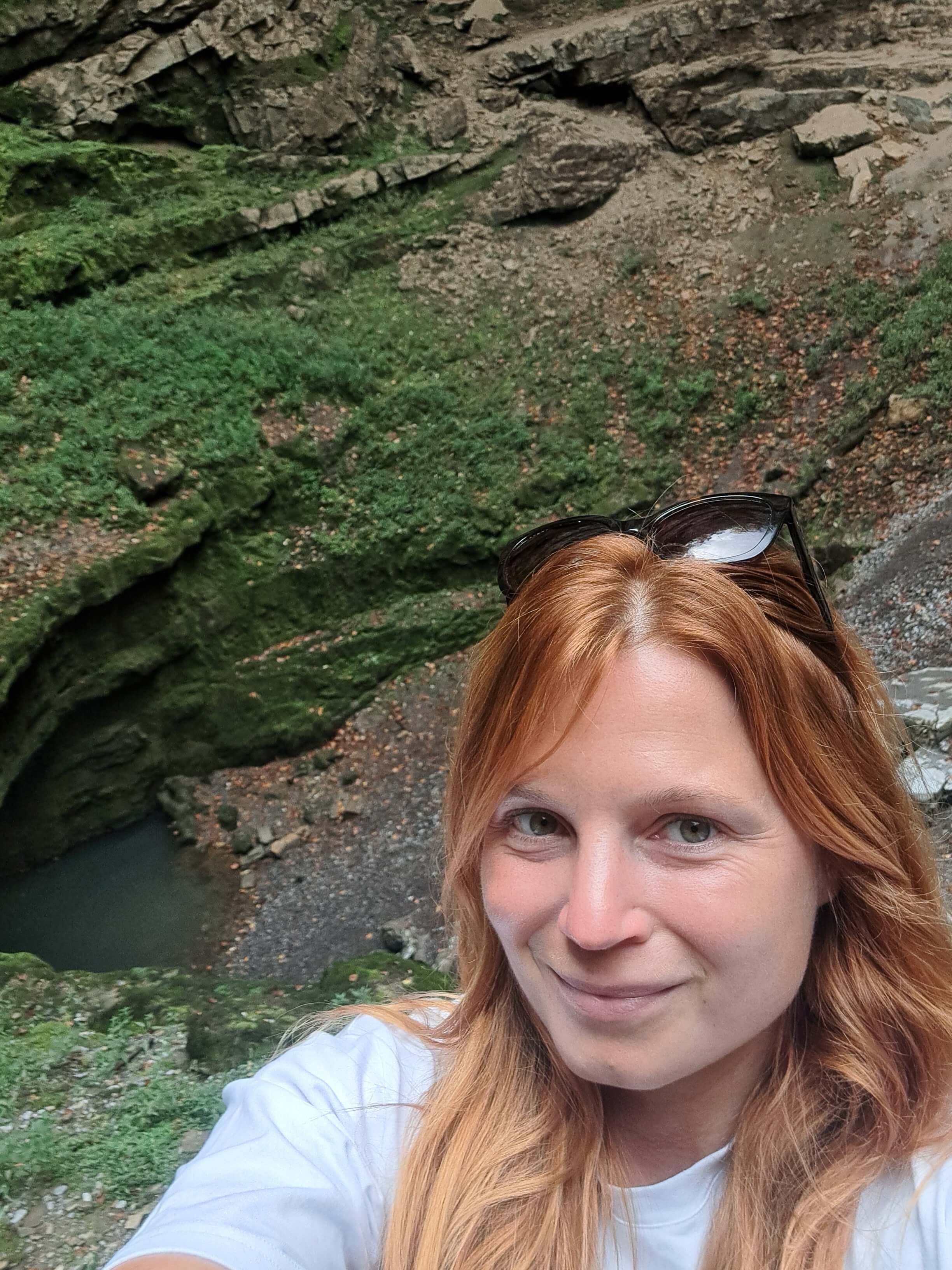
So where do I stand in all this?
I can’t reform the whole world of cave diving on my own. But I’m not on my own anymore. IDF gave me trust, a free hand, and scale, and those aren’t nice extras for a CV. They are power. For years I was an instructor who could change the world at most on my own courses: a few students, a few caves, one season. Today I design the system. The materials I write reach every IDF instructor, and the courses I create will train generation after generation of divers. What I write into the curriculum today becomes tomorrow’s standard. I am not asking anyone for change. I am not waiting for the industry to grow up. I have the power to make this change, and I intend to use it to the fullest. How?
- The cave is no longer a backdrop. In every cave course I write for, nature is no longer just a separate chapter students survive on their way to the “real” training. It is a thread woven through the whole course, pitched at each diver’s level: what lives here, where it gets its energy, what our presence does to it, and why the water matters more than the rock.
- What matters gets tested. Environmental knowledge is assessed just like gas planning or navigation: not as a bonus trivia question for the keen few (who are often in short supply), but as something a diver cannot get certified without. If a student can finish a course without knowing what lives in the water, the course has failed. And I am responsible for that course, so I will make sure it does its job.
- I start with the people who teach. An undertrained instructor is a design flaw, so I fix it at the source. Instructor candidates get the knowledge, the arguments and the skills to pass this on, because divers learn respect for nature from someone they respect, not from a paragraph in a manual.
- Cave divers will get their own path into nature. I am building programmes that let cave divers grow in a field that, for reasons nobody can quite explain, has remained the domain of recreational diving for years: observing and understanding ecosystems. The cave track will offer courses focused on getting to know underground life, observation, measurement, and real support for scientists, the kind Reef Check has given recreational divers for years. No cave equivalent exists, so we will build one from the ground up. It will take time. But we will change the game.
- Stay with me. Keep a close eye on me. Judge me on results, not promises. Better still, join me and let’s rewrite the rulebook together. The industry will change anyway. The only question is whether it changes with you or without you.
All of this means paperwork, teaching and endless arguments with colleagues (and believe me, I’ve had plenty of practice!). But I am convinced it is the only way to protect underground nature effectively: every course is taken by a new generation of divers, and each of them may dive for decades.
I am not interested in who was to blame in the past. I am interested in who takes responsibility today for the next generations of cave divers.
I’ve just put my hand up.
Not on my watch
The woman from my story deserved a better course.
But above all, caves deserve better divers. Of all environments, we chose the most hostile one. This environment will never find better advocates and ambassadors than us – cave divers.
Somewhere in the Balkans there is a swallow hole that looks like a puddle full of dead flies. Beneath its surface, creatures crowd that need no light and can wait years for a decent meal. I want every cave diver who ever stands at the edge of a hole like that to know who is waiting down there.
If they don’t know, that isn’t their fault. It’s the fault of whoever trained them. I have the tools, the influence and my name on the manuals to change that. So I’m changing it.
Not on my watch.
Author: Daria Dobrowolska
